Wednesday, October 29, 2008

My First Real Fish


One of the most vivid memories of my youth was the time I caught my very first big fish.

Must have been about 8 and in the third grade. Went with Dad to a small pond located somewhere near Tomball, which was sure enough out in the country in those days.

We were not having any luck catching anything. Couldn't even get the small perch to bite. I was at that stage when I was just learning how to cast with a rod and reel. I asked Dad if I could borrow his nice Shakespeare rig and practice casting. He said: "Well, since I'm not having any luck, sure go ahead. I'll walk down the shoreline a way with a cane pole and see if I can at least catch some perch."

So, he put a heavy "Devil's Horse" topwater lure on the line of the rod and reel and gave me a few pointers on how to cast it at a distance and how to tug on the line in such a way as to make the lure mimic a small swimming fish.

I remember how fun it was just to watch the wriggling action of the lure as I gently tugged on the line.

I told Dad I would not know what to do if a big bass were to strike because I'd never caught anything larger than a perch.

As Dad walked away he said: "There's not much chance of you catching anything right now because it's about noon and it's hot and bass generally are not feeding at this time of day. So, you don't have to worry about a big bass striking. It will be good practice for you to work on casting."

After practicing on casting for a while I began to get tired of it and had decided to forget about fishing and instead to go find a good place to go swimming.

So, I was reeling the lure back toward the shore, just watching one last time at how the Devil's Horse looked like a real fish swimming along the surface of the water.

Then, all of a sudden something happened that scared the daylights out of me. The lure was only about 6 yards away from the bank, and there was a loud splash as a very large bass attacked the lure and jumped high out of the water.

I was so shocked and surprised that I completely forgot about the rod and reel, which popped right out of my hands.

Fortunately, Dad was returning and saw what was happening. He had enough presence of mind to jump down the bank and grab the rod & reel just before it disappeared into the water.

He handed the rod to me. "Here. You caught him, so it's up to you to bring him in."

I had heard stories about how a large mouth bass can really put up a fight, and I'm here to tell you, those stories are not just "fish tales." That fish literally dragged me into the water. But I stood my ground and landed him, even if it was in the shallow, muddy water. By the time I grabbed him by the lower lip, Dad had a bass net and he jumped in the water and worked the bass into the net.

He was really proud of me, and I was grinning from ear to ear.

When we got home, Mom prepared the fish by lightly dusting it with a corn meal mixture, and she then pan fried it. I've never tasted better fish in my life.

Also, I've caught quite a few fish since then, but I've never quite captured the magic and thrill of the time I caught my very first "real" fish.

Saturday, October 18, 2008

Wedding Photography


It's been a while since I included a slideshow in a post. Here's an audio slideshow of a wedding that I photographed some time ago. The wedding was the joyful union of Jeff Lopez and Terry Shirley, two very special and talented people. If I enjoyed photographing every wedding as much as I enjoyed photographing theirs, then I would gladly be a full-time wedding photographer. The slideshow includes music, so you may need to adjust your volume.

Thursday, October 9, 2008

Austin Showcase


The city of Austin is one of the many great places to visit in the great state of Texas. It's a growing metropolitan city, and yet there are places within the city limits that retain the natural beauty of the Central Texas Hill Country.

The photo above, which I took during a recent vist, shows Downtown Austin reflected in Town Lake.

One must-see place in Austin is The Oasis restaurant, which is considered the "Sundown Capital" of Texas. Time your visit to The Oasis so you can see a sunset, and you will see why the place has the nickname. The sun setting over the lake is one of the most glorious natural wonders you will ever witness. Be sure to take a good camera (not a cellphone camera or a cheapie point-&-shoot), because you will want to take sunset pix.

Another must-see place is the State Capitol building. On most days, the Capitol building is open to the public at no charge and you can freely roam around outside and inside. The Rotunda has some very stunning architecture, both inside and outside.

Also, climb to the top of Mount Bonnell and enjoy a panoramic view of Lake Austin and the nearby upscale neighborhoods. From the summit, you will also be able to view the downtown area and the UT Tower. There are nice, sturdy stone steps leading up to the summit, which make the climb relatively easy. And the views you will see when you reach the top make the effort worthwhile. The photo above is a sample of the panoramic views you can see. Mouse over the photo and click for a closer view.

Please click on the link below if you want to see an Austin photo gallery that I recently created.

Austin Scenes

Thursday, August 28, 2008

Cotton Pickin'


Sandy & I recently went to see Memom & Pawpaw Tex (her parents), who live on a farm near Bellville. During our visit we got to see something that a lot of city folks don't have a chance to see -- cotton harvesting.

The top photo shows the harvester (which you could call a Cotton Pickin' Machine). You can click on the photo for a closer view (then press backspace to return to the post). Notice the 8 silver-colored arms in the tractor front (just below the driver). Those act like powerful vacuum cleaners and they neatly whisk the ripe cotton right off of the plant stalks, and then the cotton is quickly blown into a large storage bin behind the driver.


The next photo shows the harvester driving down rows of cotton, harvesting thousands of cotton bolls from 4 rows at a time. If you look carefully, you will notice that the harvester driver is talking on a cell phone.


Whenever the harvester gets a load full of cotton, the driver hauls the load over to the processing area. Once there, the harvester driver dumps the load of cotton into a huge steel-framed compressor bin and another worker begins to tightly pack down the cotton in the bin using a powerful hydraulic compressor. The photos show the driver off-loading the cotton into the steel-framed bin, and then the hydraulic device tamping down the cotton inside the steel casing. You really have to click on the smaller photos and access the larger photos to get a better view of the operation.

When the compressor operator cannot pack any more cotton into the steel case, then the sides of the case are loosened and a tractor moves the large bin to a new location so that the filling and compressing process can start all over again, as illustrated by the photo at left. Tex stated that one large block of the tightly compacted cotton is the equivalent of about 16 standard bales of cotton. The large blocks of compacted cotton are loaded onto big trucks to be hauled away for the wonderful transformation into cotton clothing (the "fabric of our lives" as the advertising slogan so aptly describes it).


The next photo shows some of the very straight rows of cotton as the fluffy stuff ripens in the sun and awaits the harvesting process. And the subsequent photo provides a close-up view of a cotton boll. As we watched the workers harvesting and compressing the cotton, Sandy and I would sing snatches of the familiar song that was a Credence Clearwater Revival hit a few years back:
"When I was a little bitty baby my momma would rock me in the cradle, in them old cotton fields back home.
"It was down in Louisiana, just a half a mile from Texarkana, in them old cotton fields back home.
"Now when them cotton bolls get rotten, you can't pick very much cotton, in them old cotton fields back home.
"It was down in Louisiana, just a half a mile from Texarkana, in them old cotton fields back home."

Friday, August 15, 2008

Nikon D700


I recently purchased a Nikon D700, the first truly "pro level" camera I have ever owned. The camera is somewhat on the pricey side, however it is loaded with great features and is already receiving some of the most positive reviews ever awarded to any digital SLR. My main reason for wanting the camera is the way it can take very clean photos with little or no digital noise, shooting available light (no flash) at very high ISO settings (2500 and above). This will be very useful because at work I shoot indoor photography in which using a flash is either prohibited or would be very distracting -- basketball & volleyball games, theatrical performances, etc.

In this post I will include some of the first pix I've taken with the new D700 to demonstrate the versatility of the camera. I will include some technical info and provide some background just because I find such info interesting. If the technical info bores you, then skip it and just enjoy the photos. You can see a larger version of any photo by simply mousing over it and clicking it, then press the "back" button to return to the post.


'Clean'
This first photo was taken at 6400 ISO shooting available light (no flash) with a Nikon 50mm f/1.8 lens. The shooting mode was set to Aperture priority and the f/stop was set at 7.1, which produced a shutter speed of 1/125. Notice how the photo is "clean," meaning it has minimal digital noise. This photo has about the same level of digital noise as most other digital cameras produce shooting at about 800 or 1250 ISO. Those who keep up with digital camera technical developments know that such an accomplishment is nothing short of revolutionary.


Flash
The next three photos were taken in our Marketing office at work. The three photography nuts, myself, Aaron and Kyle, put together a portable backdrop (light gray, seamless paper). We used a three-light wireless flash setup, to wit -- the primary light was a Nikon SB600 firing into one black-backed silver reflective umbrella. The hairlight behind the backdrop was an SB800 firing through a "homemade" gridspot (fashioned by Rob). The secondary (fill) light was an SB800 equipped with a colored gel filter and firing through a "homemade" snoot (fashioned by Rob, the original "Do-it-Yourself" cheapskate). We did this exercise for several reasons -- to learn how to use some of the new equipment we recently ordered, and to experiment with different lighting effects, and to experiment with different blur-action special effects. We used the D700 coupled with a Nikon 50mm f/1.8 lens. Another thing I really like about the D700 is that the camera is "full frame," which means that the Nikon 50mm f/1.8 (one of my favorite lenses) is now much more useful. With a D70 (my other Nikon camera) the 50mm lens is actually a 75mm lens, due to the 1.5 crop factor, which means the 50mm is not really a medium focal range general purpose lens, but rather a short telephoto lens. With the D700, the 50mm is now a true 50mm and is ideal for general purpose and everyday photography.

No noise
The next photo is taken of Kyle, shown "slaving away" at work. I shot this photo availabe light (no flash) at ISO 5000 with the in-camera High ISO Noise Reduction option set to the High level. The lens was a Sigma 24-60mm f/2.8. The f/stop was set at 5.6 and the shutter speed was set to 1/100. Even when you take a close-up view of the photo you will notice a very low level of noise. I made an 8x10 print of the photo with our color laser printer at work and was amazed at the detail and minimal amount of noise.


Nature
Here's another high ISO photo taken at the Cockrell Butterfly Center, one of my favorite places for photography. Technical specs -- D700 coupled with a Tamron 70-200m f/2.8 lens (outstanding glass just recently released); ISO 5000; aperture set at f/16; shutter speed set at 1/400. I shot the photo hand-held, using available light with no flash. Being able to shoot at ISO 5000 enabled me to crank up the aperture to allow a greater depth of field. It also enabled me to crank up the shutter speed so that the action could be better "frozen." I made an 8x10 print of the photo with our color laser printer at work and was once again amazed at the detail and minimal amount of noise. The bottom line is that I simply would not be able to get this particular photo with any other camera because of ISO limitations.

Action
Here's an action shot to demonstrate focus tracking of fast-moving subjects. Like the high-end D3, the D700 features the Expeed image processor, which provides 51-point 3D tracking to provide responsive coverage of fast action. This photo is one in a series of pix shot in the Contiuous "busrt" mode at 5 frames per second with the AF selector set in the Dynamic mode and the Continuous Focus mode (designed for sports). Specs -- ISO set to 320, matrix metering, shooting in Program mode (the camera chose an f-stop of 9 and a shutter speed of 1/320). The lens used is a Phoenix 100mm f/3.5.

Skin tones
I included the final photo (below) of this little essay to demonstrate how the D700 handles skin tones. Technical stuff -- Sigma 24-60mm f/2.8 lens; 5.6 f/stop; shutter speed of 1/60; ISO set at 320. I used a Nikon SB600 Speedlight with a Joe Demb bounce-type flash diffuser. This is a photo of 3 students at a San Jacinto College cosmetology event. The camera is set at the default saturation level of "Standard" and there was no post-processing. You can click on the photo for a closer view and notice in particular how natural looking the skin tones are of all three subjects. All in all, I'm very pleased with the initial results from the D700 and it's fun to experiment and learn what all can be accomplished with this very versatile and responsive camera.

Friday, July 11, 2008

Crossroads in Concert


These photos show Crossroads performing live in a recent concert. The band is very versatile, performing a wide range of soft rock and classic rock songs, mostly from the 1960s and 1970s. They hired me (freelance) to take pix and to put together a photo collage. The collage is the final photo in the slideshow.

Thursday, July 10, 2008

Nature


Hope you enjoy this tapestry of landscape, plants and animal photos I have taken during some of my ramblings. I try to have a camera handy at all times, because there are always so many beautiful and wondrous images to capture in God's great big wonderful world.

Firefighters in Action


Here's a slideshow of San Jacinto College Fire Technology cadets during "wet" training. They work in teams to attempt to bring a runaway high-pressure hose under control. The hose has the metal nozzle removed to avoid causing injuries. Got soaking wet taking the pix, but I also had a great time. They hoisted me up in a snorkel ladder bucket for the aerial shots.

Wednesday, July 9, 2008

Firefighters in Action (Part 2)


Recently took photos of San Jacinto College fire protection technology students training at the La Porte VFD training complex. They have to wear hot, heavy protective gear and train inside fiery buildings. (The buildings are specially designed to take the heat without damage). I have a lot of respect and admiration for anyone dedicated enough to go through such strenuous and demanding training.

Sunday, July 6, 2008

Mikey & Ian


Recently set up a home studio for a photo session of my niece Mikey and her boyfriend Ian. Pix include individual portraits of Ian, followed by portraits of Mikey, and then followed by photos of the 2 together, and then concluding with some carefree, candid photos of Mikey. The slideshow includes background music, so you may need to adjust your volume.

Sunday, June 29, 2008

New & Improved


The Central Library in Downtown Houston recently reopened after an extensive renovation project. The library got an extreme makeover and thorough upgrading, featuring new computers, drastic changes in design and services and other changes. Click on the link below to view a photo gallery that showcases some of the changes.

Library

Monday, June 23, 2008

Texas Scenes


Hope you enjoy this slideshow of pix I've taken in my ramblings around the Texas countryside. The slideshow was created in iPhotos, then uploaded to Photobucket, and then embedded into Blogger. There's background music, so you may need to adjust the volume.

Friday, June 20, 2008

What is it?


What is in the photo? Can you tell at first glance?

If you guessed a cell phone, then you would be correct. It is a dis-assembled cell phone and it's placed inside of a sealed jar of rice.

Huh?

Let me explain.

Like most women, my wife Sandy loves her cell phone and she keeps it with her at all times. During a recent heavy thunderstorm, she rushed from the car to her office and in the process did not realize she had dropped her phone right beside her car in the parking lot.

The phone stayed in the parking lot for a couple of hours, getting fairly wet from the rain. For a while it was dead. Then after the phone began to dry out, the service began to return, sporadic at first and then a little better over time. But some features, such as the phone's ring tone, were not working.

She told her sister Janeen about dropping the phone and how it got wet. Janeen told her that sealing the phone with rice was supposed to help in the drying-out process. So, that's the way the phone came to be sealed up in a jar of rice.

And after an overnight stay in the Rice Hotel, her phone was back to normal with all features working. So, if you ever get your cell phone wet, I recommend trying the rice treatment.

P.S.
I cooked and ate the rice used to dry out Sandy's cell phone and was amazed at the distinctly flavorful taste. I think it was caused by all the spicy gossip the rice absorbed during the drying-out process.

Friday, June 13, 2008

Lyrics

Song lyrics are amazing in their power to paint mental pictures and to evoke feelings or emotions.

I can distinctly remember graphic song lyrics I heard in my childhood, like Nat King Cole singing: "Red sails in the sunset, way out on the sea; please carry my loved one, home safely to me."

I also clearly recall sitting in my Chevy Corvair during my high school days the first time I heard Bobbie Gentry sing her masterpiece "Ode to Billy Joe," which begins with some of the best lyrics in the history of songwriting: "It was the third of June, another sleepy, dusty Delta day; I was out choppin' cotton and my brother was balin' hay; And at dinner time we stopped and walked back to the house to eat; And Mama hollered out the back door "y'all remember to wipe your feet" And then she said "I got some news this mornin' from Choctaw Ridge. Today Billy Joe MacAllister jumped off the Tallahatchie Bridge."


And anyone from my generation can probably tell you exactly where they were and what they were doing the first time they heard The Beatles burst on the scene with their high-energy songs and catchy lyrics such as: "and when I touch you I feel happy inside. It's such a feeling that my love, I can't hide, I can't hide, I can't hide."

Speaking of The Beatles, lyrics to their songs clearly illustrate how the group -- probably the most important and influential band in modern history -- drastically changed before their highly-publicized break-up in the 1970s. For example, it's a mighty long way from early lyrics like: "Love love me do, you know I love you, I'll always be true. So please, love me do" to some of the lyrics in later Beatles songs, such as: "Yellow matter custard, dripping from a dead dog's eye." Sort of graphically illustrates just how strung out and messed up they were in the later stages.

My favorite lyrics have always been the kind that paint clear mental pictures, such as these lyrics from the Kris Kristofferson song made popular by Janis Joplin: "Windshield wipers slappin' time, I was holding Bobby's hand in mine. Feeling good was good enough for me, good enough for me and Bobby McGee."

My least favorite lyrics are those that are shallow, superficial, insipid and yet stick in your head. Remember the days of "Bubble Gum Music?" I think the phrase evolved from the teeny-bopper chicks who listened to the junk while they smacked on bubble gum, but perhaps it came to be called Bubble Gum Music because, like a big wad of bubble gum, it tends to get stuck in your head and you can't get it out. Classic examples: "Yummy, yummy, yummy I've got love in my tummy" and "Oh, Sweet Pea, won't you dance with me? Woncha, woncha, woncha dance with me?" And I think the worst sort of Bubble Gum Music was the garbage known as disco music, exemplified by K.C. and The Sunshine Band. Their big hit was "That's the Way I Like It." The very deep and profound lyrics to the song go like this: "That's the way (uh huh, uh huh) I like it." Those lyrics (and those lyrics alone) are repeated about 15,000 times over and over again.

I stopped listening to popular radio music in the mid-1970s because the songs just kept getting worse and worse -- junky lyrics that you couldn't hear anyway because they were drowned out by even junkier loud music. And popular music nowadays is for the most part one huge pile of garbage. It's not in any way melodious, edifying, entertaining, fun, relaxing or enjoyable. It's just very obnoxious noise that gets on my last nerve.

So, perhaps anyone who can remember the good old days of real music from back in the 1950s, 60s and early 70s can talk about some of your favorite lyrics.

Friday, May 30, 2008

Talent Pool (featuring The 3 Drips)


Talk about talent ...

In our Marketing office we have three guys who possess the rare ability to make a very realistic "drip" sound.

I kid you not. aAron, Kyle and Rob have mastered this highly-coveted skill. Anyone of The 3 Drips can make a drip sound so realistic that, if a stranger were to hear the sound and was unaware of the origin, then he (or she) would swear that the sound was the result of a leaky roof.

On any given day in our office and at any give time, any one of The 3 Drips might snap off a loud drip sound, just to sort of provide a pleasant background noise.

I (meaning Rob) began perfecting the fine art of "dripping" in elementary school. Most of my teachers really got on to me whenever I would make the sounds during quiet times (such as assigned reading periods). Never could understand why they could not appreciate a little background enhancement sound effect.

aArron is also highly gifted in making other very cool sound effects. You really ought to hear him thump his throat. (I also sometimes call aArron just "AA" or "Double A" because he is long and thin, sort of like a AA battery. Well, he is tall, but the word "thin" might be a little less than accurate, but hey, we are Marketing and our job is to make things look good).

You also ought to see AA fool people with his fake slamming-a-door-in-his-face move. He is so slick with it that the first time I saw him pull it off, I actually thought he had really hurt himself.

Double A's self-assigned nickname is "Geezer" (coz he ain't no spring chicken anymore) and he claims he can also pull off a really convincing falling-down-the-stairs stunt. I keep trying to get him to try it on the stairs here at the District Office, but he keeps putting me off, using his age factor as an excuse. aA also boldly claims he has at one point in time "fallen UP a staircase." Such a stunt seems scientifically impossible and I have told him so (more than once). Yet, he insists he has done it and even claims there were eyewitnesses to the feat. And I still say: "I will believe it when I see it." (Falling up a staircase ... puh-leeeeeze).

Kyle (aka Karl) is also gifted in regards to making other way cool sound effects. He's a very talented percussionist (plays drums at his church) and you ought to hear the sounds he can get out of his desk, laptop and other surfaces in his cubicle. I sit right next to him and I get to hear these rhythmic sounds all day long. The tapping sounds might get on the nerves of other people, but I'm also a percussionist (prosumer level) who also has an uncontrollable "tapping" habit, so I can relate.

Rob also has other very impressive talents, such as the crafting of paper airplanes. He can also blow spit bubbles, which is a rare inherent talent that cannot be taught. These bubbles resemble the kind of bubbles you can produce with those bubble-blowing kits you can get in the toy department.

He got in trouble in the 4th grade when he was standing in line, waiting to have a spelling assignment graded by the teacher. He crafted a very large spit bubble and launched it into the air. The bubble gracefully landed on the eraser of the teacher's red pencil. The teacher studied the bubble and asked (in a very threatening tone of voice): "Is that bubble saliva?" and wanted to know who blew it. Several of Rob's friends looked at him and started laughing (which was a dead give-away). The teacher's report led to a sound spanking from dad.

Which shows to go you that some people just do not appreciate real talent, but I hope you do.

Friday, May 16, 2008

A Whole Nuther Kuntry


Never forget when we moved from Houston to the Lufkin area (due to a job transfer). I'd always heard East Texas was like "a whole nuther kuntry," and boy howdy, it sure nuf really is. A body almost has to learn to speak a new language in order to communicate.

Shortly after we arrived, I went shopping at a local supermarket. The lady walking in front of me was pushing a shopping cart with the little daughter seated in the child's seat and the little son seated on groceries in the basket. The little boy pulled the girl's hair and the mother promptly called out (very loudly): "Jimmy, I told you to turn her a'loose."

Not long after that, I was talking to a new work buddy, Brian, and we were discussing destination options for a fishing trip we were planning. He was an easy goin' ol' country boy, born and reared in the East Texas Piney Woods and he just didn't like to make decisions. So, his contribution to the planning of the fishing trip was: "Don't make me no never mind." During the two years we lived in East Texas, I heard that expression "Don't make me no never mind" numerous times and it always grated on my nerves like chalk scraping across a chalkboard. Elementary school teachers always stressed avoiding double negatives. I think that expression is actually a triple negative.

Then there was my other work buddy James, another native East Texas good ol' boy with a penchant for double negatives. Anytime a body would say something that he found hard to believe, his typical reply of disbelief was: "It ain't nuther."

After hearing Brian repeat the phrase "Don't make me no never mind" a few times, and then hearing James spout his "it ain't nuther" a few times, I recalled how I had been told that moving to East Texas was like moving to a whole nother country. It occurred to me that it's also like moving to another time zone -- backwards in time about 100 years.

Native East Texans also have the strangest way of backing into phrases. For example, if you ask a buddy which route he'd like to take on a trip, his reply might be something like: "Don't make me no never mind. Everhow you want to go is jes fine with me." Or it might go something like this: "Everwhich way you think is best suits me jes fine." Or if a pit bulldog gets a good grip on somebody, a native East Texan would say something like: "That ol' dawg turned him everwhich way but loose." Actually, to true East Texans, a pit bulldog don't really get a good grip on anything. What he does is he gets a "holt" of him.

That reminds me of the time we were in our office adding up our sales figures for our monthly report to send to the main office. Brian stopped in the middle of writing his report and asked: "Hey Rob. How do you spell 'helt?'" I replied: "I'm not sure. Use the word in a sentence." His answer was: "Well, I want to tell them big bosses down there in Houston that my sales helt up real good during the month of July." My answer: "Oh, in that case here is how you spell the word: h-a-i-l-t." Brian spelled out the word and studied it for a while and said: "Hmmmmm. Don't look right, but if you say that's how it's spelled, then it must be OK."

Which reminds me of the way East Texans butcher the pronunciation of many words. For example, they pronounce the word "can't" as though the word rhymes with "paint." And they also omit certain sounds, so that the word "help" is pronounced "hep." If, for example, you were to ask a buddy to give you a hand tilling your garden, you might get this reply: "I'd love to hep ya, but I cain't. The ol' lady tol' me I gotta run over to Brookshure Brothurs to git some groceries on my way to the house."

And if you ever want to hear an East Texas good ol' boy get real passionate about something, just get him to talking about bush hogs. (For the uninitiated, a bush hog is a tractor equipped with a large, high-powered mowing attachment for clearing overgrown property). They love their bush hogs almost as much as they love their Red Man chewing tobacco and Skoal snuff. Typical bush hog story might start out something like: "Tell you what. Got me a new John Deere bush hog and that sucker'll wack down brush as thick as a man's arm. I ain't lyin' If I'm lyin' I'm dyin' I'm tellin' ya. Jest chews 'em up and spits 'em out like a pit bull. I'm tellin' ya, when yer strong, yer strong ..." And the whole time Jimmy (or Billy) is telling his bush hog story, his buddy Tommy will be nodding his head in agreement while he either spits tobacco or rearranges his snuff by using his index finger to poke it around in his lower lip.

Anyway, anytime you get a notion to step back in time, just travel up Highway 59 for about 130 miles and maybe turn off the main road and hop on over to, say, Etoile, or maybe Dezavalla, or maybe Huntington and just hang around a place where the locals hang out and listen to them shoot the breeze. But don't listen too long, because if that East Texas twang ever gets a good "holt" on you, it's liable to turn you "everwhich way but loose."

Thursday, April 24, 2008

Photographic Odyssey (Continued)


Coming or going?

Continuing with my photojournalism essay featuring some of my favorite photos taken in my capacity as Communications Coordinator for San Jacinto College. If you want to get a better view of any photo, just click on it (and then click the "back arrow" to return to the post). The first two photos in this post might play tricks with your vision. Can you tell by looking if the students in the photos are walking toward you, or walking away from you? I like these kinds of photos which feature low lighting and a very long depth of field and have extremely "back-lit" subjects because of the crazy special effects that can be achieved. I was able to get these shots "hand-held" without using a tripod only because I used my Nikkor 18-200mm VR lens. The vibration reduction feature allows me to get such slow shutter speed photos in low light settings. Also, the vast focal range (from 18 to 200 mm) allows me to quickly zoom from wide angle to super telephoto range, which bypasses the need for changing lenses.

Que paso?

The next photo also showcases the versatility of the 18-200mm VR lens, which allowed me to capture this pix of the 2 Latino students in very low light and at a slow shutter speed of 1/40. The focus was sharp enough so that the pic did not require any sharpening or any other post processing. I zoomed in from a good distance and they never even knew I took their photo. Kinda cool being an invisible paparazzi.

Wet & Wild

The next photo features cadets from San Jacinto College's firefighters' academy. The scene is a training drill in which the cadets were learning how to control high-pressure fire hoses. The firefighter operating the ladder truck took me way up with him in the basket of the hydraulic ladder to allow me to take aerial photos. Just for grins, he cranked up the powerful spray nozzle that extends from the basket to give the cadets a little surprise shower from "on high." We got a chuckle when we saw them scatter like a bunch of ants.

Warriors

Next, we see two students at a North Campus fun day trying to keep their balance as they do battle in one of those inflatable bouncy thingies that are so popular these days. I intentionally over-exposed the photo and shot with the sun behind the subjects in order to produce a silhouette effect. I think silhouettes offer variety and a change of pace and can produce some interesting and dramatic images, as long as a person does not go overboard with them.

Role Model

The final photo for this blog post features Dr. Robert Vela, San Jacinto College North's Dean of Student Development. I consider Dr. Vela an outstanding educator, an all-around great guy, and an exemplary role model for Hispanics. I include this image in my "favorites" collection because I like the lighting, color and composition. For lighting, I relied on ambient lighting, along with one wireless remote SB600 Speedlight firing through a white translucent umbrella, mounted on a portable lightstand and placed slightly to the left and in front of the subject. The camera is a Nikon D80. The lens is a Tamron 28-75 mm f/2.8, shooting at 50mm, with a shutter speed of 60 and an f/stop of 5.6. I applied some vignette effect in Photo Shop to achieve a slight fading of the background in order to isolate and "spotlight" the subject.

Friday, April 11, 2008

A Photographic Odyssey

The top photo was captured during a campus fun day of a student who volunteered for the dunking booth. This shot made my favorite list because I like the detail of the soaking wet shirt and the "action" of the image. Yes, it's "still" photography, but I can almost see the guy moving as he climbs out of the dunking tank.

A FEW OF MY FAVORITE THINGS
One thing I love about my job as Communications Coordinator for San Jacinto College is that I get to take all sorts of photos in all sorts of settings, which can be very challenging, but also very rewarding.

Ever since I first picked up a 35mm Single Lens Reflex camera many years ago, I have been fascinated and enraptured by still photography. Sure, video is an amazing medium and still photography could never compete with video in regards to action. But still photography has certain advantages over video because photography "freezes" forever a certain moment in time or a certain emotion or a certain special occasion so that that moment or that emotion or that occasion can be savored and cherished for many years to come.

In this photographic odyssey, I will share some of my personal favorite pix that I have taken since I came on board nearly 2 years ago at San Jac. Along the way, I will provide some background (and probably some technical info) about each photograph as a way of enhancing the pix. Sometimes, the story behind the capture of certain pix can be very interesting and informative. IF YOU WANT TO SEE A LARGER VIEW OF ANY IMAGE, SIMPLY CLICK ON IT. Then, either click the "back" arrow, or click the "close box" of the enlarged photo to return to the post.

CHEERS
I got the two shots of the cheerleaders gathered in a circle by accident. As I was leaving a photo session in which I just took standard shots of the cheerleaders doing their crazy jumps and gyrations, I had an impulse to get them to gather around me while I laid down on the gym floor. After taking their pic from that perspective, I sort of liked it, so I said: "Now, let's try it the other way around. Ya'll lay down in a circle on the gym floor and I will take a photo from overhead." The results were sort of interesting and I think the pix sort of capture the close-knit comradery of the cheerleader group.

SUPER CHEF
The next photo features Donna Jones, who is the kitchen manager for San Jacinto College North's culinary arts program. She proudly displays a medal she won in a state-wide culinary contest. I like this particular photo because of the way the subject is so well lighted and isolated from the surrounding kitchen, which is dimly seen in the background. I achieved this effect by making adjustments with a Joe Demb flash diffuser so that the light from the SB600 Speedlight would be concentrated on the subject, and by increasing the camera's f-stop to achieve the desired depth of field. This is one main reason I stick with Nikon camera equipment -- because Nikon's Creative Lighting System is so versatile.

SHALL WE DANCE?
I did not need a flash to capture the next image because I intentionally shot "available light" using our Marketing Department's Tamron 28-75 f/2.8 lens, along with a Nikon D80. The Tam lens is a gem because of the large aperture (which lets in lots of light and allows for a shallow depth of field and creamy out-of-focus area [aka bokeh]). I like the way the 4 dancers are all in syc and the angles of their arms and legs. I also like the vibrant colors and patterns of the dancers' outfits.

FLY GUY
The next photo made my "favorites" list mostly because of the warm, friendly smile of the guy in the photo. The event was the unveiling of some new state-of-the-art training airplanes for the College's pilot training program. To stage a photo, I snagged this guy because he's a recent San Jac grad who is now teaching in the College's program and asked him to hop up in the cockpit. At first, he just sat there, just waiting for me to take the photo. I knew that would be a ho-hum photo, so I asked him to give me a big smile. "While you're at it, why don't you wave to me like you're about to take off on a test flight." That made the guy loosen up a bit and he broke out in this truly great smile. Amazing how a simple hand wave and a big smile can turn a boring photo into something with some pizazz.

CUTE KIDS
The next photo shows a group of children gathered around Kathy Greenway, director of the childcare center at San Jacinto College North. Greenway won a prestigious award and I wanted to get a shot of her together with some of the little ones. You just never know what you might get when you gather a group of small kids for photos, but you know at least a few of them will probably be cute. Several of these kids are cute, but the little girl on the far left, to me, is especially adorable.

SHARP
I like the super sharp focus of the next photo of the guy approaching the soccer ball. This is perhaps the sharpest sports photo I've ever taken (and I've taken thousands of them) and here's something interesting about this shot -- I got it using a D70 (considered by many to be only a "consumer" grade digital SLR) coupled with a Tokina 100-300mm f/5.6-6.7 lens. The lens is a very inexpensive "budget" lens that cost me only $80 new. The zoom mechanism is the old-style push-pull kind, instead of the newer twist-style. It aint much for looks, but I have gotten some stunning action shots using this Tokina low-cost lens. Most of the shots I've captured with the lens are every bit as good in regards to sharpness, color, clarity, etc. as pix taken with Nikon or Canon lenses that cost nearly $2,000 each. The only way to appreciate the sharpness of the photo is to click on the smaller pic in order to view a larger version.

OMG !!!
The next photo is all about the expressions. I staged the photo to go along with a press release about the Central Campus' theatrical production of "Rocky Horror Show." The show is rather racy for a college production due to the skimpy outfits worn by the cast members. The couple in this scene are supposed to be very "straight-laced" and conservative and this is their first impressions of a character who depicts a transvestite. I think all three characters really came across well with their expressions. I love to take theatrical pix. Most actors love to ham it up for a camera, which makes it easy to get great shots.

HANDS-ON LEARNING
The next photo is also all about expressions. The guy in the center is a San Jac student who is helping two elementary school students in a hands-on science demonstration. I really like the expressions of all three people in the photo. They are all obviously having fun while doing something educational. To me, this photo clearly depicts literal "hands-on" education at it's very best.

JAM
I really like the lighting in the next photo. This was one of the first photos I ever took using a Demb diffuser and it clearly demonstrates the magic of the device. A Demb diffuser accomplishes 3 things simultaneously -- it sends out indirect lighting by deflecting it from the "flip-it" device; it provides more indirect lighting that bounces off the ceiling; and it softens and evenly spreads out light through the diffuser shields. The result is almost always a photo with very evenly distributed light and proper exposure. The pic features North Campus music professor Carol Morgan jamming with student Stephen Forse, who went on to play trumpet with the Glenn Miller Band once he left San Jac.

SQUISH
No, the guy in the next photo is not getting smacked in the face by a brick. What resembles a brick is actually a soaking wet sponge. He's a student who volunteered to be a target in a sponge toss booth during "Student Involvement Day" at San Jacinto College North. What I like about this photo is the way the slower shutter speed allows the rapidly moving sponge to have a blur, which gives the impression of action. I also like the way I was able to capture the shot just when the sponge was about to make contact. Believe me, I had to take a bunch of shots to time it just right.

JAZZ
I really like 2 things about the next photo -- 1. the bokeh (out of focus area); 2. the simple way the photo "tells a story," which is at the heart of photojournalism (my favorite style of photography). I captured the image at a district-wide Christmas party held at the Central Campus. Musical entertainment was provided by a 4-piece jazz band and I took several pix of each performer as part of chronicling the events of the party. This particular close-up of the trumpet player was my favorite of the band photos, simply because the emphasis is on the very end of the horn (where the music emerges). It was not possible to get such a perspective by taking pix of the other musicians, which included a drummer, a bass player (upright bass), and a pianist.

SPLASH
Now we come to a series of 6 related photos that feature San Jacinto College firefighter technology students participating in a rigorous training session. The object of the training was for cadets to attempt to bring under control an out-of-control spraying fire hose. This is a critical part of firefighter training, because a fire hose that gets away from a firefighter can quickly become a lethal weapon, whipping around the solid steel spray nozzle, which can do a lot of damage to people and property. In this exercise, the steel spray nozzle was removed from the fire hose as a safety precaution. I used a fisheye lens for some of the pix, which produced some interesting results. A cadet operating a firetruck equipped with a long extension ladder was nice enough to allow me to go high up in the air with him (in the basket of the ladder) to allow me to get some pretty cool aerial pix. I had a blast in the photo session, even though I got soaking wet.

WOO-HOO !!!
The next photo demonstrates how trying something a little unorthodox can sometimes change a routine, hum-drum, boring photo into something that's at least a little more attention-getting. I was taking a pic of the North Campus speech & debate team to go with a press release about the many awards & trophies the team had won in recent tournaments. I shot a few of the traditional "Castro" photos of the group (line them up and shoot them). Then, just before taking one final shot, I had a sudden impulse to liven things up a bit. I told the group: "Let's do something a little different. I want each one of you to hoist your trophy and shake it and shout and really whoop it up and celebrate all your hard-earned victories." The students really got in the spirit and I really liked the resulting photo, especially the individual expressions of some of the students.

PLAY BALL
The next baseball photo is another unplanned shot I got by "accident." I had been taking action shots of the North Campus baseball team to be used in a media guide and when I was finished and was about to leave the field, I happened to glance down to some equipment laying around in the dugout area. Something about this particular collection of fielder's glove, baseballs, and cap caught my attention and I quickly snapped a close-up. To me, the dirt smudges on the cap and the well-broken-in fielder's glove holding 3 baseballs sort of exemplify the uniqueness of baseball and the sport's rich traditions. Bettina, one of Marketing's very talented graphic artists, really liked the photo and it was used as a screened background image on the back cover of the 2008 media guide.

PICTURE PERFECT
The next photo was taken of North Campus President Dr. Charles Grant in his office. This one made my favorites list not because of anything special about the content, which is pretty basic and routine. What I like about the photo is the perfectly distributed lighting, the extremely sharp focus and the true-to-life color rendition. This photo was so "just right" when transferred from the camera that it required no post-processing, which is vary rare. The photo shows off how great the combination of a Nikon D80, a Tamron 28-75mm f/2.8 lens and a Demb diffuser work together to produce properly exposed, sharp pix with rich and accurate colors.

LOOKING AHEAD
The next photo again demonstrates how trying something a little different can change a routine photo into something that at least portrays a message. I took the pic to go with a press release about a new educational consortium recently launched by Dr. Robert Vela and Dr. Sarah Janes, 2 very talented and dedicated educators at the North Campus. They started the project because they said they have a vision of a better educated North Channel community, which will help to improve the local economy. Rather than just take the typical "Castro" photo (line them up and shoot them), I decided to try something that would convey the idea of a vision for a brighter future. To do so, I placed a single flash high up on a light stand and fastened a "snoot" to the flash (which simply constricts the light so that it becomes a focused spotlight) and had the two subjects look up toward the light. They both really liked the photo and I think the result was at least an improvement over the typical photo of 2 people just standing side by side.

LADY MECHANIC
Here's another unplanned, spur-of-the-moment shot that I took on impulse. I needed some pix to go with an article I was putting together about Kim, a really sharp young lady who is excelling in San Jac's highly-regarded auto repair technology program. I staged some shots with her and an instructor using an electronic sensor to test parts of an auto engine. I liked the pix and told them we were finished and started walking out of the auto repair shop. On the way out I got to thinking that an electronic sensor may not be the best device to convey the idea of auto repair. So, I went and found Kim and asked her if we could stage a few more pix using some other sort of tool -- something more conventional and easily recognizable. We went to the tool room and she asked the tool room clerk for a wrench. "What sort of a wrench would you like," he asked. "Give us the largest wrench you have," I replied. He provided the big wrench you see Kim holding in the photo, which was the perfect prop. I staged her holding the wrench with her arms crossed, leaning against the hood of the car to suggest a "can-do" attitude. Kyle Smith (my Communications Coordinator teammate) used PhotoShop to apply a smudge of grease to her cheek.

REMOTE LIGHTS
The next photo is one of my first attempts at using multiple remote lighting. The people are medical imaging students going through mock procedures in one of the College's lab facilities. I got the shot using 2 remote lights -- one was a SB800 Speedlight placed close to the floor on a tripod and the other was a SB600 Speedlight that a volunteer student held above the subjects' heads. Anytime I get a person to hold a remote light, I ask him or her to be my VAL (Voice Activated Lightstand). I'm still experimenting with multiple remote lighting and I'm now working on the effects that can be produced with 3 remote flash units (I love Nikon's Creative Lighting System).

PRIDE
The next photo exemplifies the changing face of many Houston area neighborhoods. The attractive Latino young lady is very likely the first in her family to attend college and she is understandably very proud of earning her degree. I have an idea that her parents also very likely sacrificed a lot to help their daughter attend San Jac North and they have every right to be equally as proud. Statistics show that Latinos are by far the largest demographic group in the North Channel area.


NURSING GRADS
The next three photos showcase the North Campus' outstanding nursing program and the program's unique Nightingale Ceremony. During the ceremony, each nursing graduate gets to recite a short tribute of appreciation. Each female graduate also goes through a ritual in which a traditional nursing cap is pinned in place.

A highlight is the closing lamp-lighting ceremony. The nursing program director lights a small lamp and then "passes the light of compassion" by using the flame in her lamp to light the lamp of one nurse, who then lights the lamp of a nearby nurse, and so on until all of the nurses stand in a line illuminated by the flames shining from their collective lamps.

I was able to get these pix shooting available light by using my Nikkor 85mm f/1.8 lens and shooting at high ISOs (which accounts for the digital "noise" visible in the pix).


SOFTBALL ACTION
The next 4 photos showcase San Jac South's ladies softball team in action.

I concentrated more on getting shots of the pitcher because they play fast-pitch softball and the pitcher is by far the most important position in the game.

I like the concentration and fierce determination that shows in the expression of the pitcher. The non-pitching photo shows a San Jac player sneaking back into second base after she barely missed getting tagged out.

Got these pix with my highly under-rated $80 Tokina 100-300mm zoom lens.

One thing I've learned about shooting ladies fast-pitch softball -- you can get some pretty decent action shots, but it usually requires some patience. At the college level, the pitchers are generally very good, which means there may not be very many chances during a typical game to get any shots of baserunners because base hits are usually few and far between. The photo I got of the San Jac player at second base was one of the few decent shots I got of a baserunner.

BRINGING SCIENCE TO LIFE
The next larger photo features 3 San Jac students and one elementary school student collaborating on a science lab demonstration during an innovative project sponsored by the Central Campus' science department. During the science fair, elementary students from many area schools visit Central's science classrooms and labs, conducting contests and learning from San Jac students, who conduct hands-on science experiments in which the children get to participate.

BASEBALL ACTION
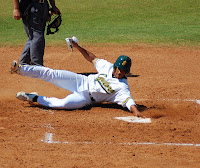
The next two photos feature two of my favorite shots of the North Campus baseball team in action. I included the shot of the guy sliding into home plate simply because I really like pix of baseball players sliding into any base. This shot in particular appeals to me because I was able to snap the shutter at the exact moment the player slapped home plate (which is no easy thing to do). I included the shot of the other player because of the clarity of the photo and because it so clearly captures something so common in baseball -- a player catching a pop-up fly ball. He's the pitcher, running to get the pop-up, but so is the catcher, so the pitcher is hollering: "I GOT IT" to wave off the catcher and avoid a collision. Look carefully at him and you can almost hear him shouting "I GOT IT."


HOT WORK
The next photo features a Central Campus welding technology student working with a cutting torch. I like the guy's focus and expression of concentration. I also particularly like the starburst effect caused by the flame striking the steel plate.


ON STAGE
Let's conclude this little project (which turned out to be not-so-little) with three photos that showcase the outstanding theater department at San Jacinto College Central. The photo of the three guys is a shot I staged during a rehearsal for their production of "Inherit the Wind." This photo session was my very first attempt at setting up a "portable studio" by using two remote flash units set up on tripods. The primary light was provided by a SB600 Speedlight with a LumniQuest Softbox attached. A secondary "fill" light came from another SB600 Speedlight firing through a Gary Fong Internal Dome diffuser placed on a tripod at a littler farther distance from the subjects. The other 2 photos feature live photos taken during Central's phenomenal performance of "Sound of Music." Both of the shots were taken available light (without any flash) using my Nikkor 18-200mm VR lens. The VR stands for Vibration Reduction and it's a very handy feature to have when shooting in low light settings because it allows you to get some fairly decent shots at slow shutter speeds (down to 1/8), provided the subjects are not moving very much.

If you'd like to see a "bare bones" photo gallery of this entire set of SJC pix (no text), here's the link ...

Favorite SJC Pix